Dad vs The Barbeque
There is a set of coordinates in the space time continuum that marks a significant milestone in the history of our family backyard barbeques. This shift might be linked to changes in our standard of living, or it could be just as easily attributed to the influence of the great American marketing machine asserting the relentless influence it is known to wield. The nexus I am referring to denotes my dad’s (and thus my family’s) transition from the standard round charcoal grill to the propane fired models that continue to dominate the market today.
My best estimate narrows this transition to the late 70’s or early 80. My confidence is supported by the fact that this timeline coincides with my family relocating from a row home in Marcus Hook to a single-family Bi-level in Boothwyn. Before this move my dad, like every other father I knew, owned one of those stamped aluminum barbeque grills that began to populate the windows of every hardware store in America in the early spring. They were round, brightly painted saucers that sat atop three hollow aluminum legs, two of which sheepishly bore modestly functional wheels. This package came complete with the matching wire grill surface upon which many hot dogs and hamburgers would be sacrificed under the unspoken barbeque code that stated nothing that ever touched the grill surface could be overdone. Like a secret handshake or a password whispered through a mail slot, all fathers everywhere knew this axiom. The grill set up was instantaneous, just pull it out of the box, make one small adjustment and you were ready to go, assuming you had charcoal and a rectangular can of petroleum distillates that randomly transmuted into nitroglycerine.
I do not recall much about my dad’s cooking technique while using this style of BBQ grill, other than to say that like every other dad I knew, hamburgers were either done to the texture of vulcanized hockey pucks, or potentially worthy of an E. coli outbreak report to the CDC.
It was a guarantee that despite being lovingly used during the summer and perhaps early fall, this aluminum refugee would begin to rust as if it were on a timer. As we reached the next grilling season, it was obvious that the annual changing of the guard was upon us. Amazingly, the replacement purchase was made without hesitation or complaint. Simultaneously last season’s tin soldier was laid to rest in the tomb of unrelenting oxidation. To this day the entire cycle invites an investigation for collusion between aluminum producers and charcoal briquette makers.
The new neighborhood demanded new standards such that one afternoon I found myself handing my dad various tools as he assembled the new gas grill that would reside on our back patio. The grill was made of what felt like bulletproof armor. Heavy, roughly formed and projecting power, the structure slowly took shape as it rose from the heavy-duty cardboard capsule that I swear had a force field generator.
Dad wasted no time in christening the new culinary status symbol. The previously purchased propane tank that had languished for days in the cool shadows of the garage was attached, and we were headed to the land of Graham Kerr and the Galloping Backyard Gourmet. At least this was the intent.
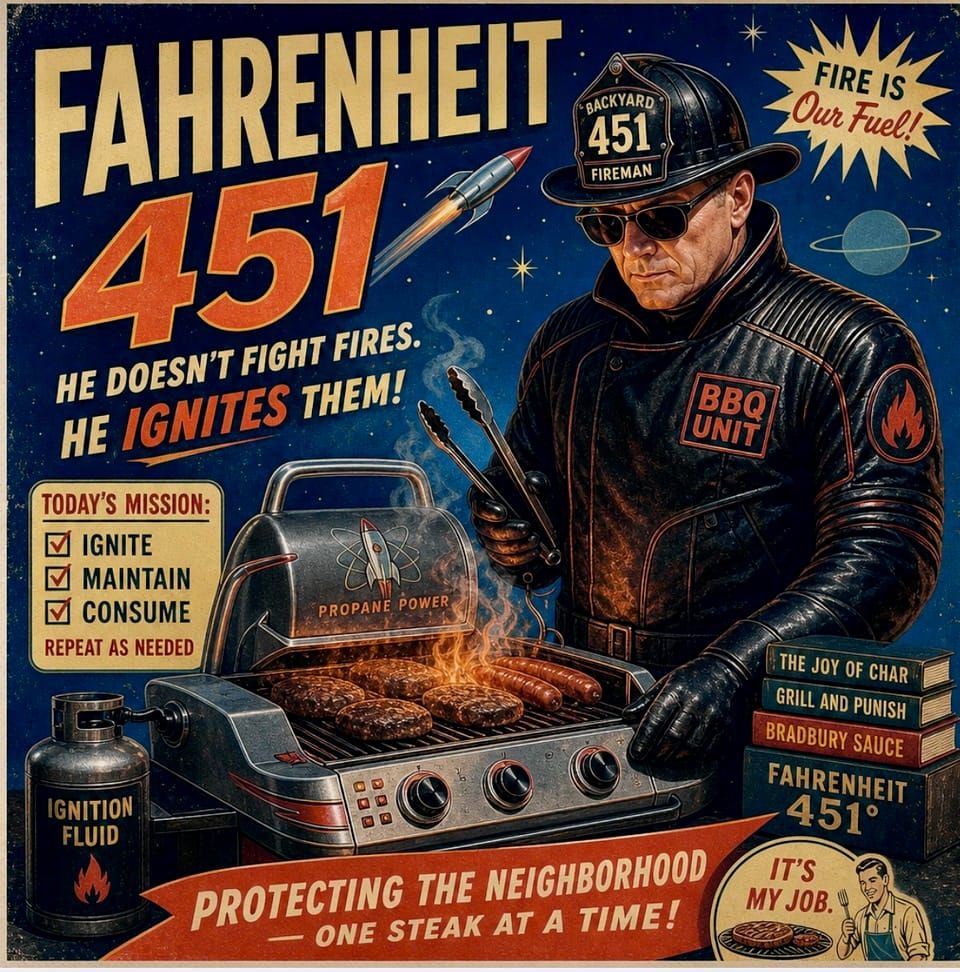
Unlike the old, slow, barbecue briquettes, the propane was more akin to a blast furnace. The power of hydrocarbon combustion provided a thermodynamics lesson from the first day. Apparently, this was not going to be like riding a bike. Picture if you will my dad, spatula in one hand, water filled plant mister in the other, and a fire breathing dragon roaring before him. My dad was not so much cooking our food as much as rescuing it from being returned to the carbon atoms it was originally borne of. Little did I realize my dad was acting out the opening line of Fahrenheit 451, “It was a pleasure to burn.” Shortly thereafter the question was would it be a pleasure to eat?